What happened after Omegle closed?
After Omegle closed in November 2023, users moved across a fragmented group of random-chat and social-video services rather than one direct replacement.

 Chamet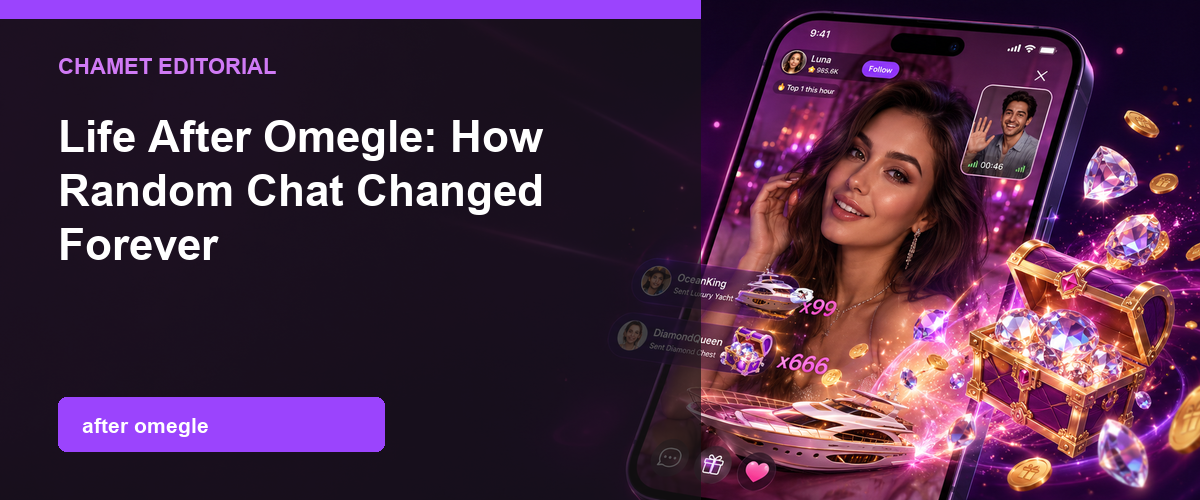
The internet did not stop talking to strangers after Omegle. It changed the terms of the encounter. The original idea, instant conversation with an unknown person, survived. What changed was the expectation that a platform should provide context, choices, and visible safety tools around that moment.
Omegle launched in March 2009 and made anonymous pairing unusually simple. Ofcom's 2022 Online Nation report described the service as a free site that randomly paired users for live calls, with no registration required and optional interests for matching.
That low-friction design shaped an entire category. Early Omegle alternatives often copied the same core loop: connect, skip, repeat. There was little profile context and no expectation that a conversation would continue.
During pandemic isolation, stranger chat gained renewed cultural attention. Instant human presence offered novelty and contact when ordinary social routines were disrupted. The strengths and weaknesses of anonymous matching became more visible at the same time.
The lesson for random chat after Omegle is that demand for spontaneous contact is real. The harder question is how to deliver spontaneity without making exposure, harassment, or manipulation feel inevitable.
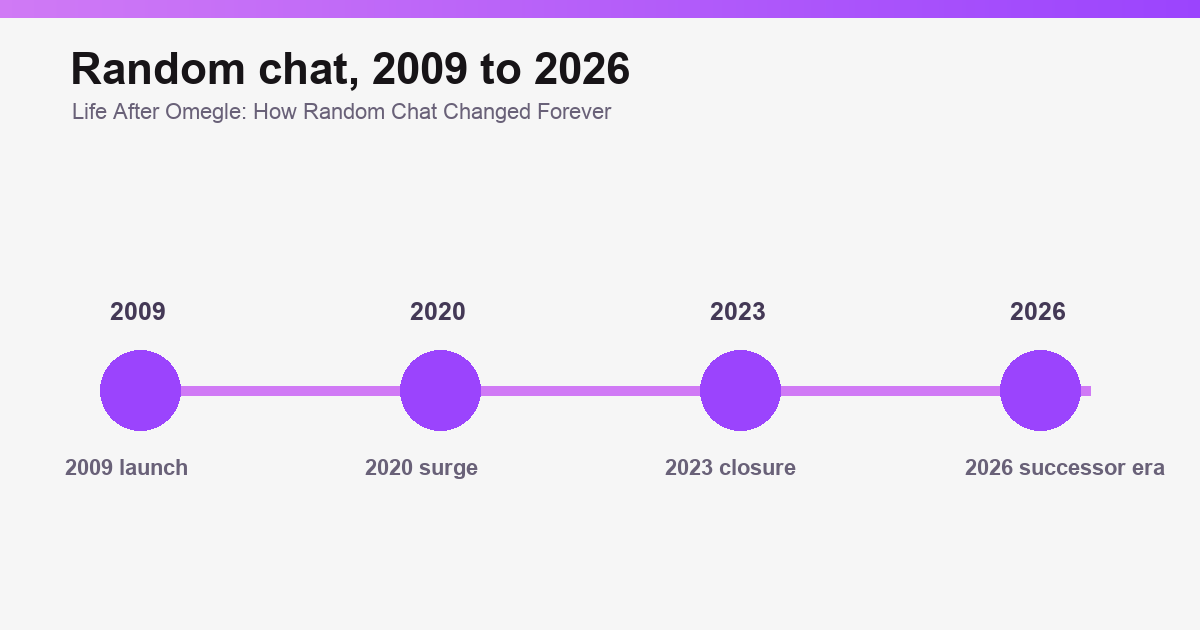
Omegle shut down in November 2023. The founder's closing statement discussed misuse of the service and the financial and psychological strain of operating it. The closure ended a specific platform, but not the user intent behind it.
Life after Omegle therefore became a product-design question: which parts of randomness should remain, and which parts should be rebuilt?
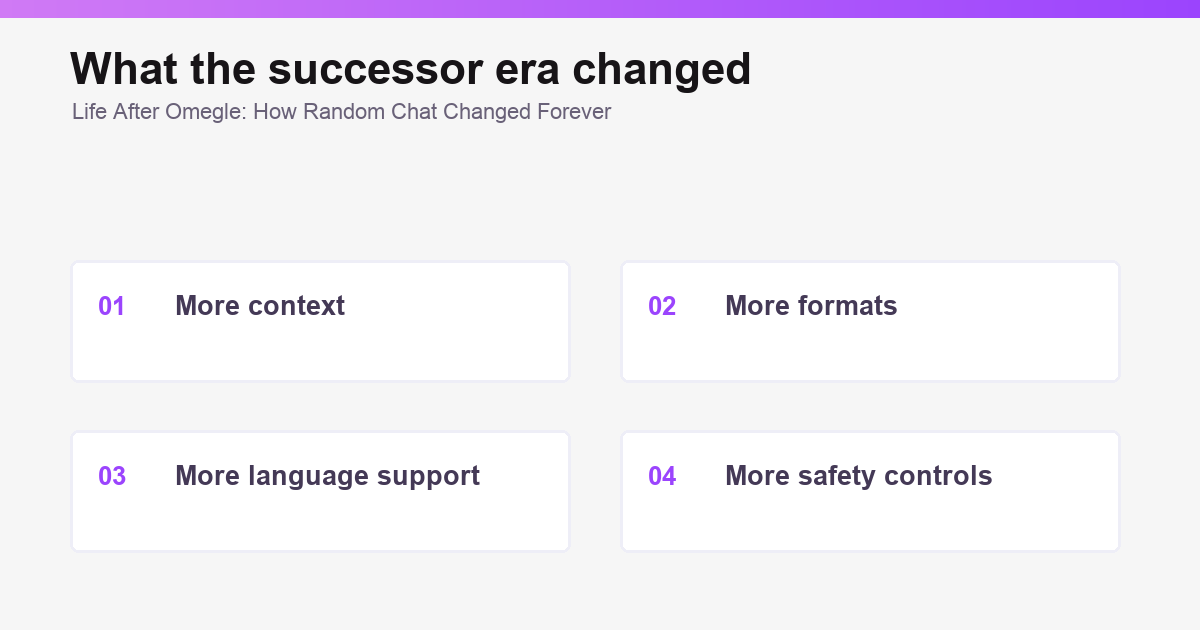
Modern post-Omegle video chat increasingly gives users something to work with before or during a call: region, language, interests, profile content, or a visible social identity. Context does not guarantee honesty, but it can make conversation more intentional.
This is a major difference among Omegle alternatives. Some still prioritize anonymous roulette. Others use random discovery as one entry point inside a larger social platform.
The old loop was binary: stay or skip. Newer platforms often combine private calls, live rooms, group rooms, feeds, voice, games, and creator interaction. Users can choose intensity instead of repeating the same format.
Chamet follows this multi-format model with 1v1 calls, live rooms, Party Rooms, voice rooms, Moments, translation, gifts, and interactive games. Chamet: 1v1 Video Chat & Live Video Call App - Make Chat Borderless presents the platform as a broader social video experience rather than a direct Omegle clone.
Interest tags helped people find common ground, but language remained a hard barrier. Translation now gives random chat after Omegle a wider possible audience. It cannot fully translate humor or culture, but it can help two people get past the first sentence.
For post-Omegle video chat, language tools also change who feels reachable. A region is no longer useful only when both people already share a language.
Omegle's history made the risks of anonymous stranger chat impossible to treat as a footnote. Users now look for adult-only rules, moderation, reporting, blocking, privacy guidance, and easy exits.
No tool makes stranger chat risk-free. However, Omegle alternatives can be judged by whether safety actions are visible and usable. Chamet's Community Safety | Chamet page states its adult-only rule and describes moderation, reporting, blocking, privacy expectations, and prohibited scams.
Before choosing a service, ask:
These questions define a more mature market after Omegle. They also help users separate a polished interface from a product that supports control.
Compare current call-first products through Best 1v1 Video Chat Apps for Real-Time Social Video. The comparison is useful because random chat after Omegle now covers very different experiences, from roulette-style matching to larger social ecosystems.
Chamet is best understood as one branch of the successor era. It keeps live discovery but adds private calls, social rooms, translation, Moments, games, and creator-led entertainment. Google Play shows more than 50 million downloads, while Chamet says the service reaches more than 150 countries.
That does not make every conversation safe or compatible. It means post-Omegle video chat can offer more paths than anonymous matching alone. Users still need to protect identifying information, refuse money requests, avoid private-image pressure, and report misconduct.
The browser experience, Chamet: Live Video Chat & 1v1 Calls with Strangers, provides a direct way to inspect the current product model.
The central idea survived after Omegle: people still value the surprise of meeting someone outside their normal circle. The durable change is that surprise no longer has to be the only feature. Context, format choice, translation, continuity, and safety can surround the match.
The future of random chat after Omegle is not less human spontaneity. It is spontaneity with more control.
'%20stroke-width='2'%20stroke-linecap='round'%20stroke-linejoin='round'/%3e%3c/svg%3e)
After Omegle closed in November 2023, users moved across a fragmented group of random-chat and social-video services rather than one direct replacement.
Strong Omegle alternatives provide clear age rules, moderation, reporting, blocking, privacy guidance, and enough context to make matching intentional.
Some random chat after Omegle remains highly anonymous. Other products add profiles, interests, regions, language tools, or social feeds.
Post-Omegle video chat increasingly combines private calls with group rooms, live content, translation, games, discovery controls, and visible safety systems.
Join millions of users and meet your next best friend today.