Is Spanish video chat useful for beginners?
Yes. Spanish video chat works for beginners when calls are short, the pace is agreed, and correction does not overwhelm conversation.

 Chamet
The fastest way to make Spanish video chat repetitive is to ask the same five beginner questions every time. A better approach is to give each call a different job. Three short sessions can improve listening, speaking, and continuity without turning a social conversation into a class.
Ask the other person where their Spanish comes from and how they describe their accent. Spanish is spoken across many countries and communities, so pronunciation, rhythm, and everyday words vary. A speaker from Mexico, Spain, Colombia, Argentina, or the Caribbean will not use every expression in the same way.
During the first Spanish conversation practice, listen for two phrases you understand and one you want explained. Do not interrupt every unfamiliar word. If you want to chat with Spanish speakers, curiosity about variation is more useful than asking which version is "correct."
Start a focused private call through 1v1 Video Chat with Real People | Chamet, then keep the first session to ten minutes so both people can decide whether the exchange fits.
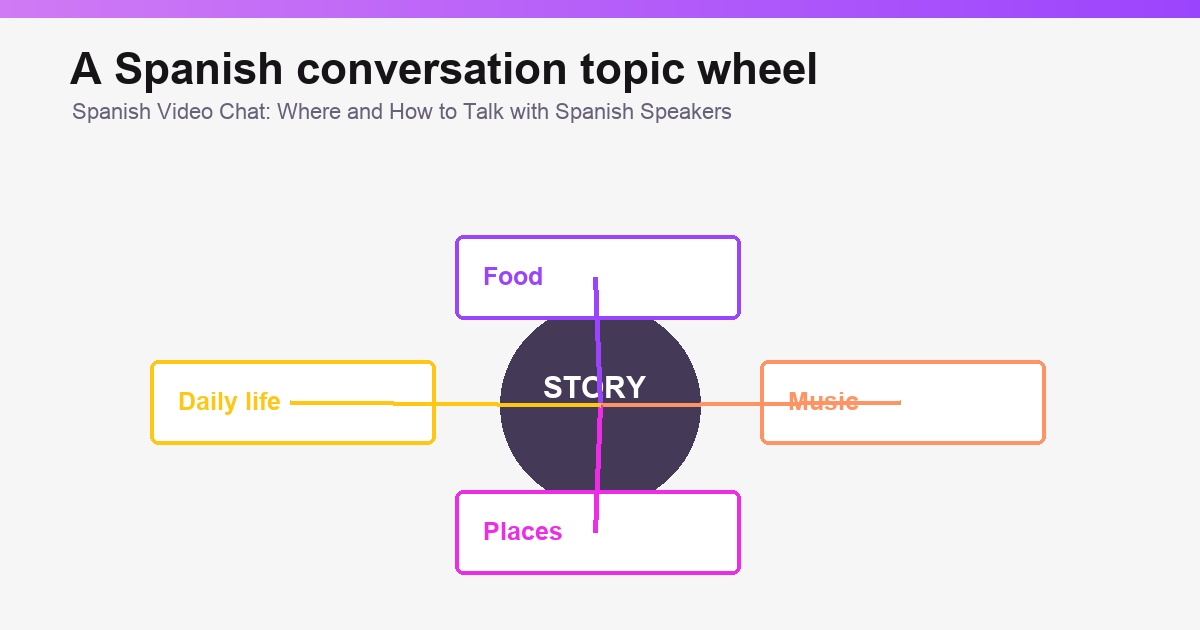
Choose a topic that produces detail: a meal you cooked, a journey that went wrong, a song linked to a memory, or a place you would recommend. Tell your story for two minutes, then invite the other person to tell theirs.
This gives Spanish language exchange a natural balance. One person is not the permanent learner and the other is not the permanent teacher. A Spanish video chat works better when both sides contribute a real story.
Use one follow-up pattern:
These questions help you chat with Spanish speakers without turning the call into an interview.
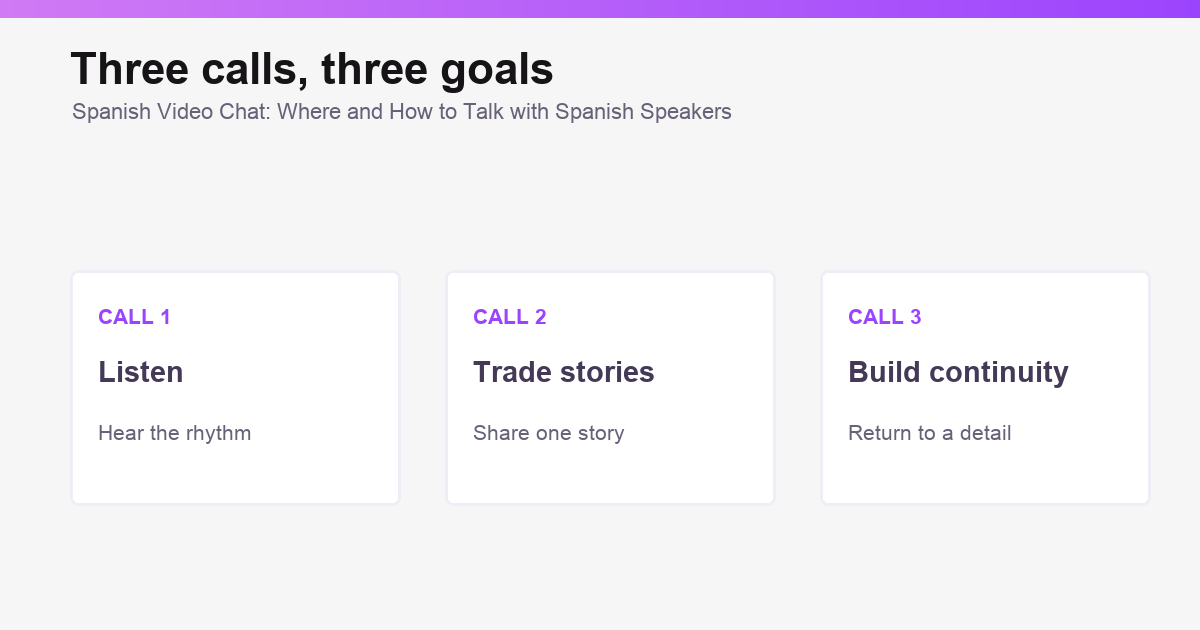
Return to a detail from the previous call. Ask whether the person tried the recipe, watched the film, visited the place, or remembered the phrase. Continuity is the difference between random contact and an emerging friendship.
For Spanish conversation practice, repeat one corrected sentence from the last session and use it in a new context. For Spanish language exchange, agree on a small goal before the next call, such as three minutes in each language.
Chamet supports global 1v1 calls, live rooms, Party Rooms, and translation. Explore those modes on Chamet: 1v1 Video Chat & Live Video Call App - Make Chat Borderless. A private call suits focused practice, while a group room can expose you to more voices and conversational speed.
When vocabulary changes, write down both forms and their regions. Do not ask a speaker to erase their accent or imitate another country. The goal of Spanish video chat is comprehension across real voices, not a single artificial standard.
If a phrase is unclear, ask for a simpler explanation before using translation. Translation can rescue a missed meaning, but it cannot fully explain humor, register, or local references. Good Spanish conversation practice includes the confidence to say, "I did not understand that yet."
Choose one of three modes before the call:
This agreement makes Spanish language exchange less stressful. It also gives people who chat with Spanish speakers a clear way to learn without making every sentence feel graded.
Do not reveal your address, identity documents, workplace, school, payment details, or account codes. Avoid screenshots or recordings without permission. If someone pushes romance, money, private images, or another platform immediately, end the call and report.
Read Community Safety | Chamet before your first Spanish video chat. Chamet states that the service is for adults and describes moderation, reporting, blocking, privacy, and scam restrictions.
You can also begin through Chamet: Live Video Chat & 1v1 Calls with Strangers. Check your connection, pick one session goal, and leave space for the conversation to change direction.
'%20stroke-width='2'%20stroke-linecap='round'%20stroke-linejoin='round'/%3e%3c/svg%3e)
Yes. Spanish video chat works for beginners when calls are short, the pace is agreed, and correction does not overwhelm conversation.
To chat with Spanish speakers, ask concrete follow-up questions, listen for regional variation, and share your own stories too.
A good Spanish language exchange divides time fairly, sets a correction mode, and gives both people a reason to return.
Two or three short sessions per week can make Spanish conversation practice more sustainable than an occasional long call.
Join millions of users and meet your next best friend today.