How many people use video chat in 2026?
There is no single authoritative global count across all products and use cases. Video chat statistics 2026 should use sourced platform figures and broader connectivity data without merging them.

 Chamet
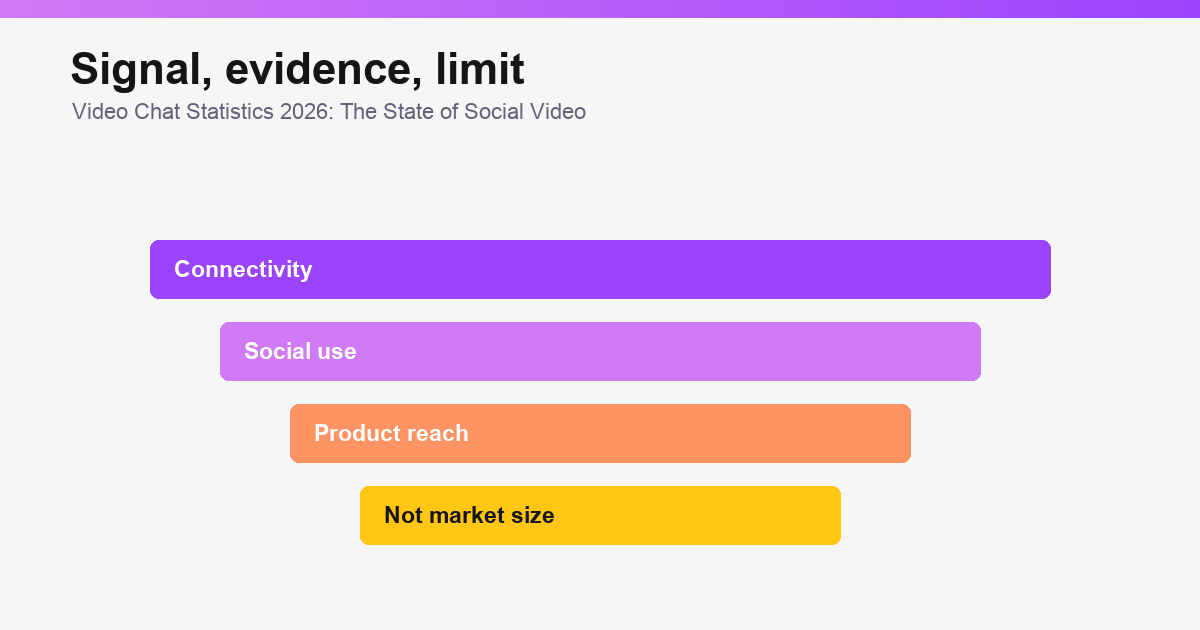
Good video chat statistics 2026 need a boundary before a headline. Public sources measure internet access, social-media identities, app downloads, and individual product features. They do not provide one universal count of people using stranger video chat. This overview reports the strongest available signals and labels the limits.
Three rules keep the numbers honest:
These distinctions matter when discussing video chat trends. They also prevent broad online video communication behavior from being mistaken for the audience of specific social video platforms.
The International Telecommunication Union reported that 6.0 billion people were online in 2025, while 2.2 billion remained offline. Its Facts and Figures report described almost three-quarters of the global population as connected and noted continuing gaps in quality and affordability.
This is the latest full-year connectivity baseline entering 2026. It expands the possible audience for online video communication, but it does not say how many people made social video calls. Any video chat statistics 2026 summary should preserve that difference.
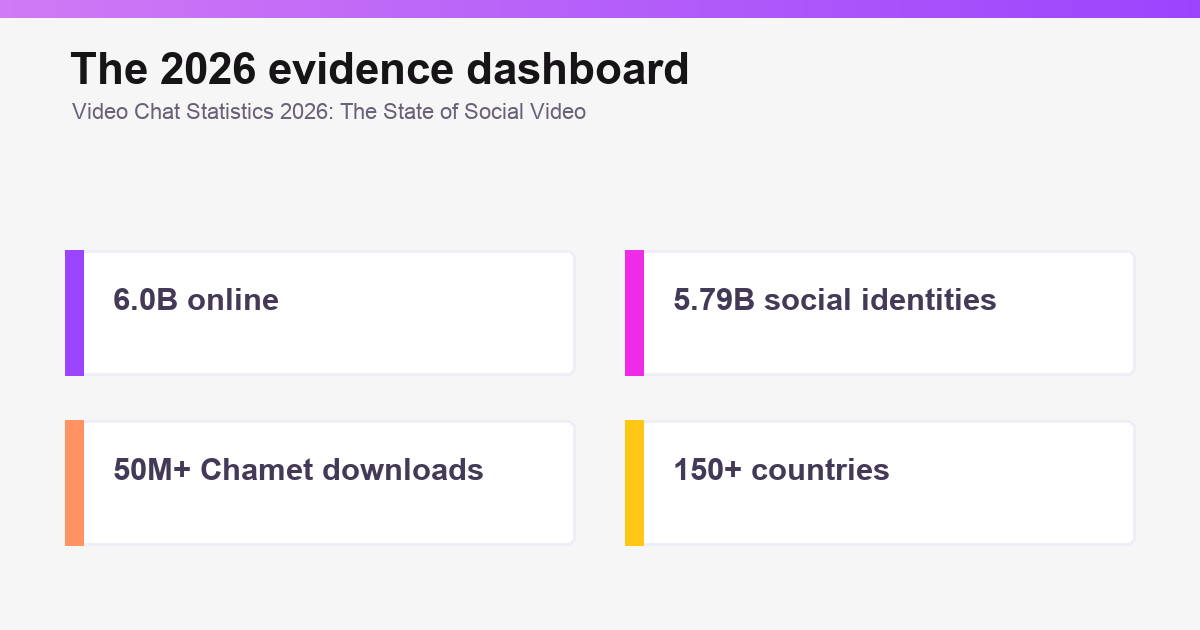
DataReportal estimated 5.79 billion social-media user identities at the start of April 2026, up 294 million year over year. It also reported that 94.7% of internet users use social media monthly. The source warns that user identities may not represent unique individuals.
For social video platforms, the implication is reach, not guaranteed usage. Social behavior is already embedded in internet life, but users can spend that time on feeds, messaging, streaming, groups, or calls. The figure supports a broad social context, not a narrow video-chat market size.
The clearest video chat trends are visible in product design. Many services no longer offer only a single random call. They combine private 1v1 calls, live broadcasting, group rooms, voice rooms, feeds, translation, gifts, or games.
Chamet is one example. Google Play shows more than 50 million downloads, while Chamet says the platform connects users across more than 150 countries. Chamet also describes private calls, Party Rooms with up to five people, live rooms, voice rooms, interactive games, Moments, and real-time translation.
Those are product-reach and feature signals. They belong in video chat statistics 2026, but they should not be converted into active-user claims. Explore the current platform on Chamet: 1v1 Video Chat & Live Video Call App - Make Chat Borderless.
ITU reports that mobile broadband coverage is close to universal, while service quality and affordability remain uneven. For online video communication, coverage alone is not enough. Video depends on latency, data cost, device quality, camera performance, and a stable upstream connection.
This explains one of the most practical video chat trends: mobile-first products need adaptive performance, quick entry, and formats that work when a full video call does not. Voice rooms and shorter calls are not only feature variety; they can be useful alternatives when bandwidth or camera comfort changes.
Language is a participation constraint even when connectivity is available. Real-time translation does not remove context, slang, or cultural difference, but it can help people begin a conversation that would otherwise stop at the greeting.
For social video platforms, translation changes discovery from "people who share my language" to "people with whom I can build enough shared meaning." That is a qualitative shift, not a public market statistic.
Compare private-call products and their feature sets through Best 1v1 Video Chat Apps for Real-Time Social Video. Use the comparison to evaluate what each service offers, not to infer audience size from a feature list.
Reporting, blocking, moderation, adult-only policies, privacy guidance, and real-person signals are increasingly part of the product surface. That is one of the most consequential video chat trends, because a fast match has little value if a user cannot leave or report safely.
Chamet's Community Safety | Chamet page describes moderation, reporting, blocking, privacy expectations, and prohibited scams. Safety pages are evidence of stated policy, not proof that every call will be risk-free. Users still need boundaries.
Together, the evidence supports four conclusions:
What the evidence does not support is a single global user count for stranger video chat. A credible video chat statistics 2026 report should say so directly.
To inspect Chamet in a browser, open Chamet: Live Video Chat & 1v1 Calls with Strangers. Product testing can answer experience questions that global data cannot.
'%20stroke-width='2'%20stroke-linecap='round'%20stroke-linejoin='round'/%3e%3c/svg%3e)
There is no single authoritative global count across all products and use cases. Video chat statistics 2026 should use sourced platform figures and broader connectivity data without merging them.
Major video chat trends include mobile-first access, multi-format social video, real-time translation, stronger reporting, and more intentional discovery controls.
Online video communication can include private calls, group rooms, live streams, work meetings, language exchange, and social discovery, so definitions matter.
Social video platforms should distinguish downloads, registered accounts, monthly active users, countries served, and call activity rather than presenting them as interchangeable.
Join millions of users and meet your next best friend today.